

Available on: the Growth plan and above.
- Connect apps AskFunnel does not connect to directly. For example Airtable, Notion, Slack or your CRM.
- Use every answer. Pick the contact’s email, phone and each answer in any module of your scenario.
- Stay in control. AskFunnel retries automatically and shows every lead in a delivery log.
- The Growth plan or above. See Upgrade your plan.
- A Workspace Admin or Global Admin role. Only they can manage webhooks.
- A Make account. Each lead your scenario handles uses credits from your Make plan, so check the plan’s monthly allowance.
- A funnel with a form. See Set up your lead capture form.
Important to note
Set up the connection
1
Create a scenario that waits for a webhook
In Make, create a new scenario, then:
- Click the first module and search for Webhooks. Choose Custom webhook.
- Next to Webhook, click Add.
- In Webhook name, type a name you will recognize, for example “AskFunnel leads”. Click Save.
- Make creates an address and starts listening. Click Copy address to clipboard.
2
Tell Make to wait for a lead
Click Run once. The Custom webhook module now waits for data. Keep this window open.
3
Add the address to your funnel in AskFunnel
- From your main dashboard, find the funnel you want to connect.
- Click the three small dots (…) on that funnel’s row, then click “Funnel Settings”.
- On the left side menu, click “Integrations”.
- Under Send leads to, on the Webhooks card, click “Settings”.
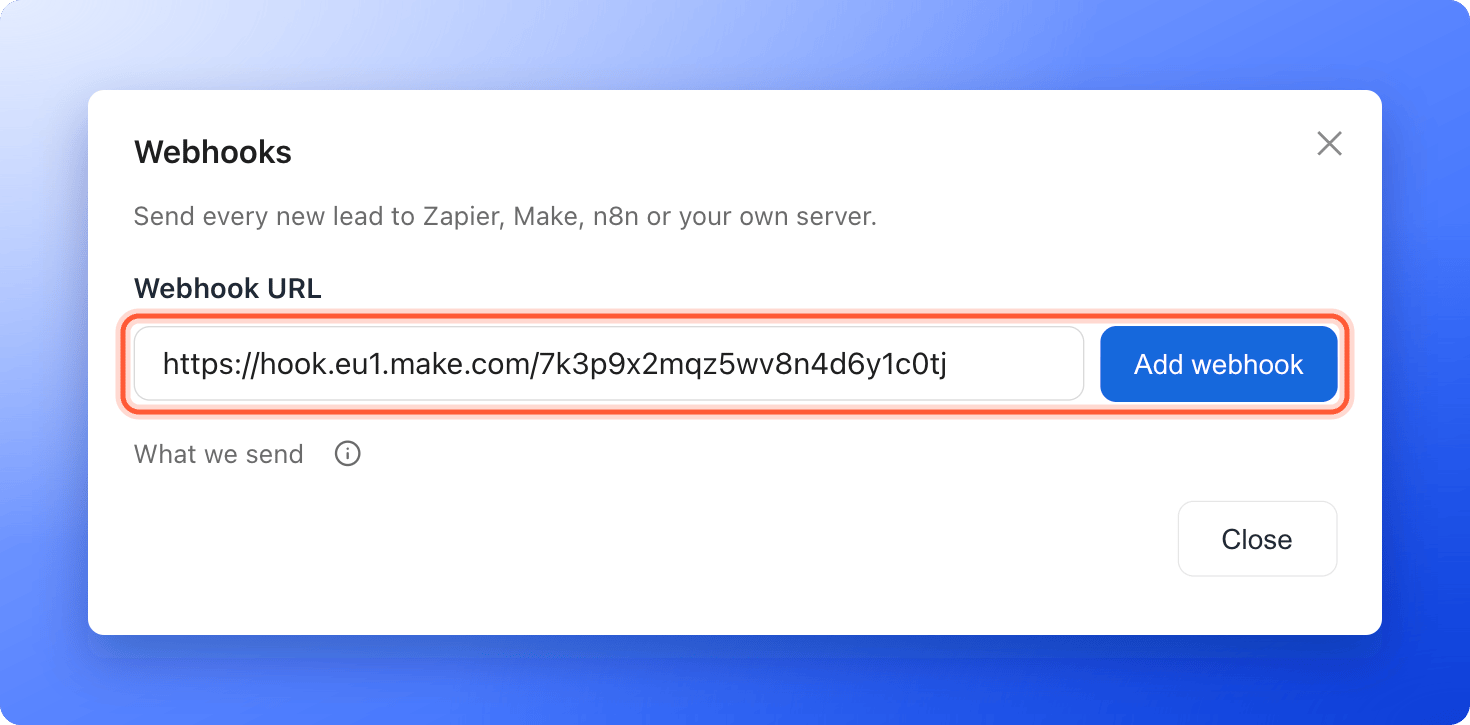
- Paste the address into Webhook URL and click “Add webhook”.
4
Send a test lead
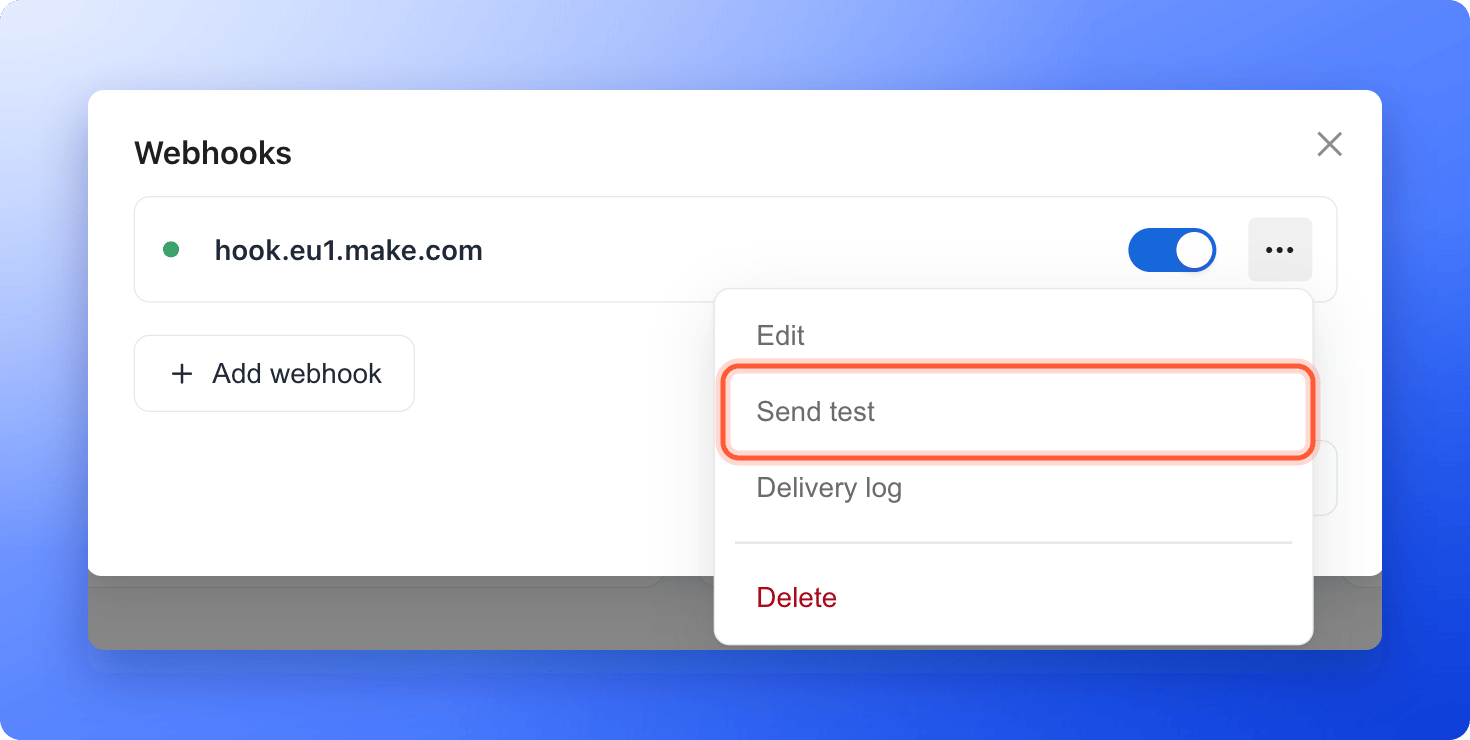
- In AskFunnel, click the three dots (…) on the webhook’s row, then “Send test”.
- You see Test delivered, for example Test delivered (200 OK). The sample lead is named AskFunnel Test.
- Back in Make, the module learns the fields of a lead from this test and lists them for the next modules.
5
Add what should happen next
Add a module for the app you want, for example Google Sheets, Airtable or Slack, and fill its fields with values from the test lead. The lead’s name, email and phone are in the contact details, and each answer is in the answers, named after your question. The full list is in What AskFunnel sends.
6
Turn your scenario on
Switch your scenario on, so that it runs each time a lead arrives. A scenario that is off does not process leads.
7
Try it with a real lead
Open your live funnel, fill in the form and submit it. Your scenario runs within moments. Delete the test lead in your other app afterward if you like.
How do I know it is working?
- The Webhooks card in AskFunnel shows Connected and the address of your webhook.
- In AskFunnel, click the three dots (…) on the webhook, then “Delivery log”. Each lead shows Delivered, Retrying or Failed. Tests are listed as Test.
- In Make, your scenario’s history shows a run for each lead.
Troubleshooting
The test says Test delivered, but Make shows nothing
The test says Test delivered, but Make shows nothing
Click Run once in Make so the Custom webhook module is waiting, then send the test again from AskFunnel. Check that the address in AskFunnel is the one from this module.
A new question does not show up in Make
A new question does not show up in Make
Make remembers the fields of the first test. After you add or rename a question, open the Custom webhook module in Make, click Detect new values, then send another test from AskFunnel. The new fields appear for your modules.
Leads show Failed and the reason says the endpoint rejected the request
Leads show Failed and the reason says the endpoint rejected the request
Make answered with an error such as 400. This can happen if you set a data structure on the webhook that a lead does not match, or if Make has too many requests waiting. Remove the data structure or fix it, wait until Make has room, then click “Retry failed” in the delivery log.
My test fails with The endpoint was not found
My test fails with The endpoint was not found
Check that you pasted the whole address from Make, with no spaces, and that the webhook still exists in Make. Other test messages are explained in Send your leads to a webhook.
The same lead started my scenario twice
The same lead started my scenario twice
AskFunnel delivers each lead at least once. If Make was slow and AskFunnel retried, or you clicked “Retry”, the same lead arrives again with the same ID. See The same lead arrived twice.
The Webhooks card says Growth and above
The Webhooks card says Growth and above
Webhooks are available on the Growth plan and above. Click “Upgrade to Growth” in the Webhooks settings, or see Upgrade your plan.
Manage the connection
- Send to Make and other tools: add up to 10 webhooks to a funnel. Click “Add webhook” in the Webhooks settings.
- Pause it: turn off the switch on the webhook’s row. Leads that arrive while it is paused are not sent later.
- Remove it: click “Delete webhook” in “Edit webhook”. Switch off or delete the scenario in Make too.
What to do next
Send leads to Zapier
Connect Zapier instead, with a Zap.
Send your leads to a webhook
Headers, signing and the delivery log.
What AskFunnel sends
Every field of a lead, for your scenario.